Nearly 60% of domestic employers believe their employees' financial situation has worsened over the past quarter, with 8% of employers reporting a significant decline. That's according to a survey of 338 members of the Czech HR Association (Svaz personalistů České republiky). How can employers help workers who run into financial trouble? And why do two-thirds of employers have no visibility into their staff's financial situation? On 22 June 2022, during an online discussion of the survey results and audience questions, panelists included Radek Hábl from the Institute for the Prevention and Resolution of Over-indebtedness, David Borges, a collaborator with People in Need (Člověk v tísni), Matěj Kučera from the National Institute of Mental Health, and Martin Fortelný from Advanto.
Recording of the webinar available here
The survey among members of the Czech HR Association asked employers whether their employees' financial situation had improved or worsened over the past quarter. Roughly 59% of them answered that their employees' financial situation is getting worse, with 9% of those saying significantly so.
"We can all see how sharply prices have risen, not just for energy but also interest rates, which then feeds through into high inflation. The situation really isn't good, and the influence employers have here is very important and absolutely crucial—maybe more important than ever before," said Radek Hábl, founder of the Institute for the Prevention and Resolution of Over-indebtedness and author of the well-known Debt Enforcement Map (Mapa exekucí) project, responding to this finding.
David Borges, a debt expert and analyst at the nonprofit People in Need, also believes more people will run into financial trouble. "We're heading into difficult months, maybe even years. I've realized we're going to have to fight on two fronts. We already have more than 700,000 people under debt enforcement, and on top of that, a completely new group of people who never used to be in that situation and never even needed to take out loans is now running into trouble. People are getting energy bill surcharges in the tens of thousands of crowns," Borges explains.
Hábl added that surveys show very few domestic households have savings set aside specifically for unexpected expenses. "40% of households admit they don't have savings larger than one or two paychecks. 15% don't even have savings equal to one paycheck. If they have no savings and they have unpaid bills, they end up in trouble very quickly," he says.
Financial problems are taboo in the workplace—that has to change
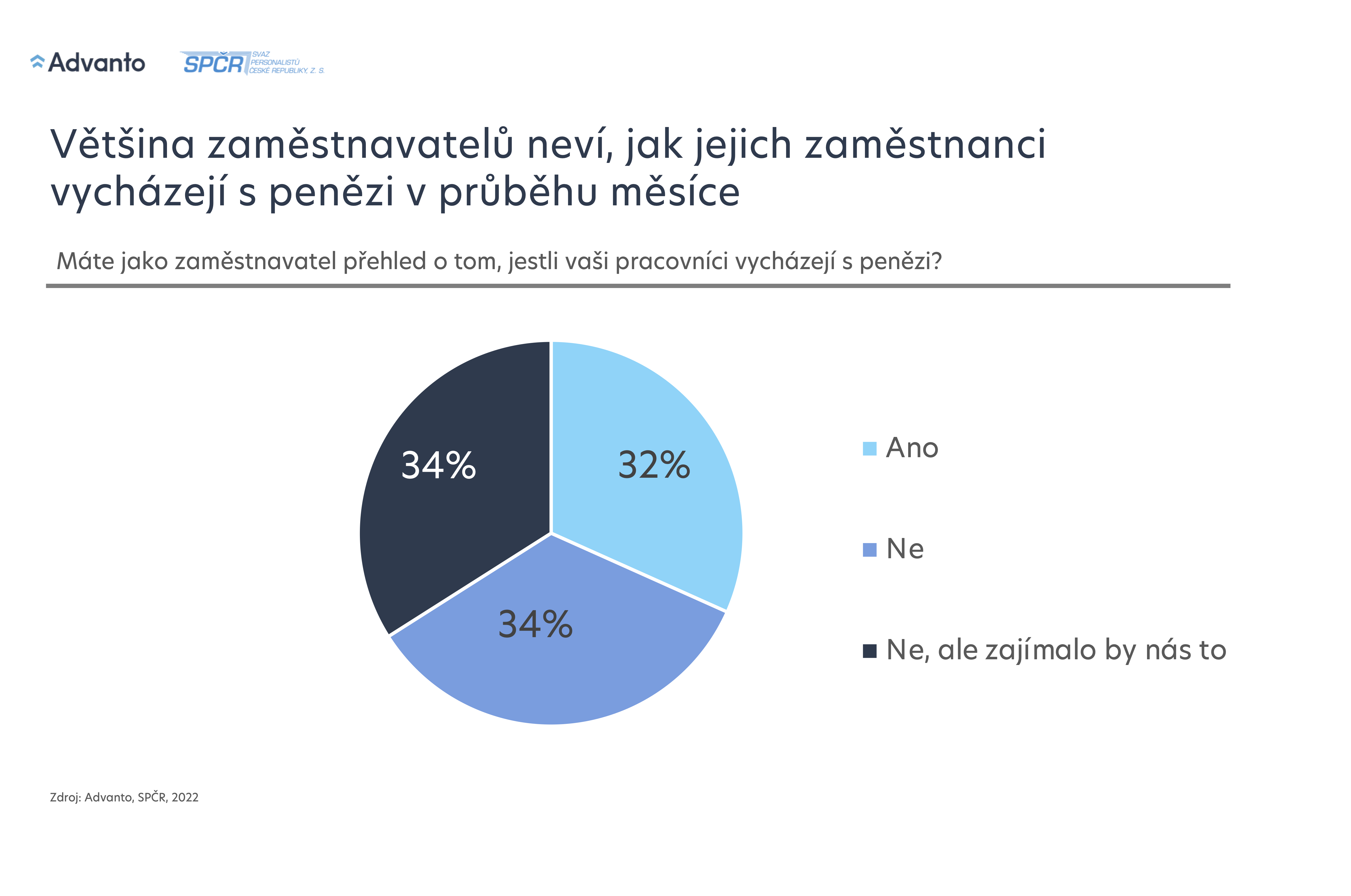
More than two-thirds of employers have no visibility into how their employees are managing financially. According to Martin Fortelný, head of Advanto, which helped conduct the survey, that's a problem. "We all know that help works best when it's targeted. But employers can't effectively help employees in financial difficulty if they never even find out that someone needs it," Fortelný points out.
According to Matěj Kučera from the National Institute of Mental Health, workplaces apparently haven't created a safe space where financial problems can be discussed. "We run into this in our research—we never ask about income, because especially with the Czech population, we recognize this is sensitive information, and when someone is asked about it, in most cases they simply refuse to answer," he says.
"We know that the vast majority of workplaces don't have an open culture—in most of them, there's no communication at the vertical level, that is, between managers and subordinates. When information sharing does happen, it happens between colleagues. Colleagues will tell each other how much they earn, but telling your HR person, let alone your manager, how satisfied you are with your finances—God forbid how you handle your money during the month, or that you have debts—that's, I think, very sensitive information, and that's why it doesn't flow in that direction," Kučera adds.
People are ashamed to deal with their financial problems at work, David Borges confirms. "Shame is a key issue here. Many times, when offering counseling at companies, we've run into a situation where not a single employee showed up to hear about how to deal with debts or enforcement proceedings. Naturally, it turned out nobody wanted their colleagues to find out they had problems. So we moved to an individual approach. And we very carefully tell HR professionals that they need to create a safe environment for employees. You always have to keep in mind that this is a sensitive topic," Borges points out.
Wage advances or Earned Wage Access can help prevent people from falling into debt
The survey found that one of the most common forms of help employers offer their employees is a wage advance. About 38% of employers offer this option. But the same percentage offer no form of help at all when it comes to preventing or resolving over-indebtedness.
According to Martin Fortelný from Advanto, wage advances—or better yet, letting the worker themselves decide when they receive their earned money—are a very effective way to keep people from having to borrow at expensive interest rates.
Radek Hábl agrees. "A wage advance can help bridge an unexpected expense that needs to be paid immediately. For example, a court decision or payment order typically has a 15-day due date, and if you don't pay it, you go into debt enforcement and your costs immediately increase by 7,000 crowns," he says.
Hábl adds that the speed at which Earned Wage Access can help is also important for debt prevention. "People get stressed. Right before Christmas, a client of mine got an energy bill settlement he didn't have enough money for. He called me in the evening saying he didn't know what to do, that he has five children and never wants to have his electricity cut off again. I told him we'd sort it out in the morning. But by then he told me he'd already solved it—he'd taken out a loan. If we'd been able to withdraw a wage advance, we would have had time to set up a payment plan, for example, and solve it in a better way," Hábl recalls.
Financial literacy education is overrated
One of the activities employers offer as part of debt prevention or resolution is counseling, including financial literacy training. However, according to Hábl, financial literacy is overrated.
"I'm a bit allergic to financial literacy, because a lot of things get blamed on it. Let's not overrate financial literacy—we have other problems, and financial literacy won't pay our bills. There's a lot of research abroad on this. One meta-study published in the Washington Post summarized around 200 study results and noted that financial literacy education affects a person's future behavior in only one in a thousand cases," Hábl points out.
Behind most debt isn't rising energy prices, but the payday-millionaire phenomenon
Hábl adds that people know they should save, but that the urge to consume wins out over the will to set money aside.
"What we know is that money acts as a dopamine booster, or sprinter. So money landing in your account triggers a fairly complex reaction that can lead toward happiness, but can also lead us into a kind of dependency," Kučera explains.
"Advanto users tell us they like to split their pay into parts, for example by week, because it gives them a better overview of their income and expenses, and it removes the payday-millionaire phenomenon—the urge to spend more right after payday because there's suddenly a large sum in the account, followed by scraping by before the next one," Fortelný adds.
According to Kučera, the so-called payday millionaire can be a genuine problem for some people. "The concept of money is hard for the human mind to grasp. When a person picked apples from a tree, it was much more natural to take as many apples as they needed at that moment than to pick the whole tree bare and try to make it last for some longer period," he explains.
It's in employers' interest to keep their workers out of the debt spiral
According to debt expert David Borges, a significant share of people under debt enforcement give up on ever getting out of the spiral. "If I've lived in the gray zone for several years, getting paid cash in hand, I have several enforcement proceedings against me, I have no assets and no real prospects, then I get used to it, and it becomes very hard to find the impulse to change my behavior," he says.
"Over the long term, we talk about the factor of not being able to see a way out of the situation—if a person falls into a long-term unpleasant situation they don't know how to get out of, the primary reaction is to submit to it, get used to it, suppress their emotions, because that's how they can gain some distance from the situation and start responding to it," adds Kučera from the National Institute of Mental Health.
According to Hábl, though, this dopamine effect and Earned Wage Access could actually help here. "When people see their pay more often, they're also more motivated to work overtime and, say, work weekends. People often think the amount protected from garnishment is fixed. It isn't. Money above the basic protected amount is only partially withheld. So if someone under debt enforcement works overtime, they still get extra money for themselves. And if they get it right away, that can increase their motivation to work more," Hábl says.