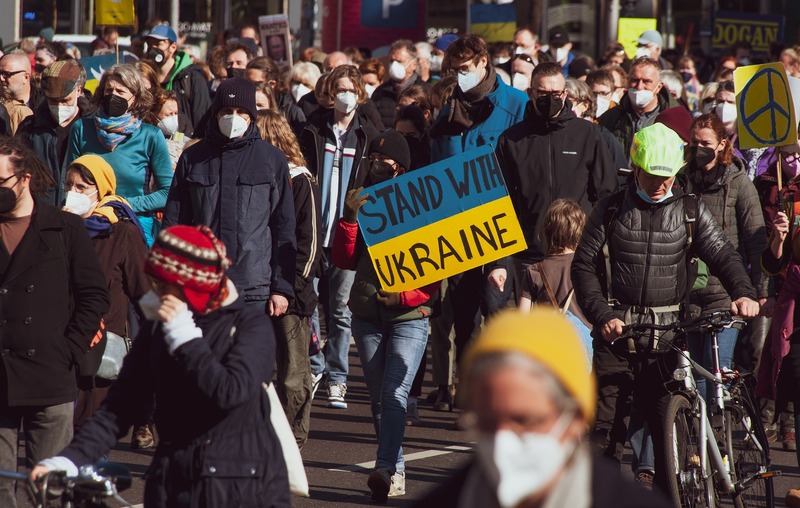
More than a month after the outbreak of war in Ukraine, around 300,000 people fled to Czechia, of whom more than 260,000 received special visas. Thanks to that, we already know that almost half of them are children and that women make up 80% of the remaining adults.
During the crisis, Czech state authorities showed the flexibility, speed, and humanity needed, opening entry to Ukrainian citizens on what was effectively a notification basis, or significantly simplifying visa obligations for existing residents. No one dares to say how long the war may continue, or whether refugees will decide to return home or settle in Czechia. If a significant share of Ukrainian citizens were to decide to stay, what could that mean for an overheated labour market?
Despite the negative effects of the pandemic, Czechia has a shortage of workers; unemployment is still the lowest in the EU (2.4% in Czechia compared to an EU average of 6.2%), which has been felt very negatively by domestic businesses and, consequently, by the domestic economy as well. According to the Labour Office, at the end of January—roughly a month before the Russian invasion of Ukraine—there were more than 350,000 unfilled job vacancies. 70% of these were jobs suitable for foreigners, the vast majority in manufacturing, technical, and blue-collar fields, but also in social services and healthcare.
Number of foreign nationals with Ukrainian citizenship living in Czechia:
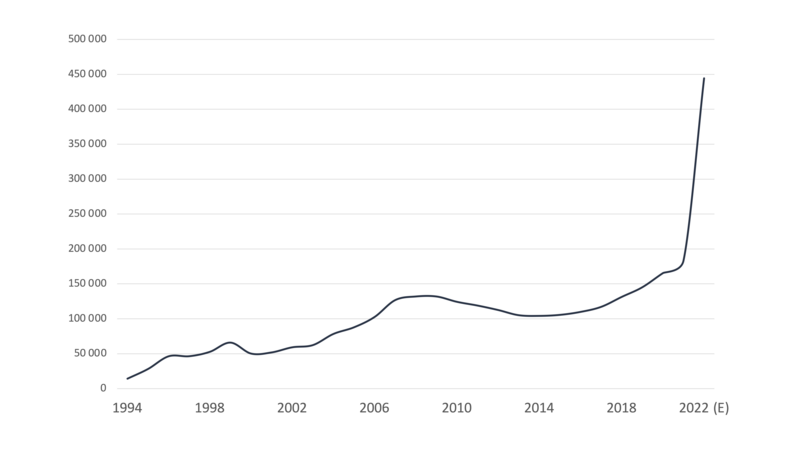
Source: Czech Statistical Office, Ministry of the Interior
One idea that comes to mind is that it is precisely the war migrants from Ukraine, many of whom have expressed interest in working in Czechia, who could fill a non-negligible share of the job vacancies on offer. The fact that this is in the interest of all parties involved was also confirmed by the swift approval of the so-called Lex Ukraine, which abolished the previously very demanding and, for many Ukrainians, previously impassable process of obtaining a work permit, and treats refugees from Ukraine as residents with permanent residence in Czechia.
Among experts, the prevailing view is that the arrival of Ukrainian residents is an opportunity for employers. According to Gerhard Knop of the Leadership Synergy Community, for example, it is also clear that companies are going out of their way to employ them, not only in order to fill vacant positions, but clearly also out of a sense of solidarity. For many employers, helping was simply a matter of course even on the days when they had to deal with the operational fallout of the conflict (disrupted supply chains, uncertainty in sales) and they threw themselves selflessly into helping families.
“Helping the families of our core employees, of whom we have more than 400 in Czechia, was a moral duty for us. We arranged several buses for our employees' family members to get them out of immediate danger. We then helped arrange accommodation for them. We just wanted to do the right thing,” says HOPI Holding founder František Piškanin.
Will Ukrainian refugees fill the gap in the labour market?
Even so, at this moment, employing Ukrainian refugees brings a number of challenges. Although, according to the Labour Office data already mentioned, the vast majority of job offers were suitable for foreigners, these are often physically demanding positions. Yet among the adult arrivals, 80% are women, since men have been staying in Ukraine—voluntarily, and from a certain point on, by obligation—to defend it.
According to ČTK, which published the results of a March survey by the company Profesia, 59% of businesses are willing to employ refugees from Ukraine on a part-time or permanent basis, even knowing that they are mostly women with children. A fifth of companies are still deciding, and the same proportion is not planning to employ refugees. According to Jana Stehlíková, an HR expert and founder of the Flecto app, the number of job offers from domestic companies has, if anything, been declining over the past two weeks.
Setting aside physically demanding professions, a further significant share of the job positions on offer is in services. Here, however, the key problem tends to be a lack of knowledge of the Czech language. English can often be an alternative, but in services, at least a basic knowledge of Czech is generally a necessity. Fortunately, given the linguistic kinship with Ukrainian, this need not be an insurmountable problem. A number of employers are also prepared to offer Czech language courses to suitable job candidates from Ukraine.
One field that has long struggled with a shortage of workers is healthcare. Women are welcome there; however, in healthcare, Ukrainians run into a further problem. Alongside the language barrier, this is proof of education or qualification. Although many of the Ukrainians who have fled to us are qualified and educated, current rules do not allow them to take up the so-called regulated professions, which require a certain type of qualification. Until this problem is resolved, the Ministry of Health has promised to allow Ukrainians to work in healthcare in other positions that do not require qualification.
The key to filling vacancies with Ukrainians? Adaptability and a genuine desire to help them
The information above shows that labour market demand does not directly meet the supply represented by Ukrainian refugees. In the vast majority of cases, people from Ukraine are immediately employable only in specific professions. Even here, though, this need not be a hundred-percent match. As already mentioned, roughly half of the migrants from Ukraine are children, cared for by their mothers, who make up 80% of the adult refugees. Employers will therefore have to accommodate their maternal duties, and demand from Ukrainian women is expected to lean toward reduced working hours and jobs with flexible working time. Further support from employers is also essential, such as faster access to pay rather than waiting a month, since the costs associated with settling in Czechia can seem astronomical (housing costs in Prague are 40% higher than in Kyiv, and on top of that, people are bringing savings based on wages that are 3 times lower).
In this respect, it is truly important to meet them halfway, because that one-off CZK 5,000 for a fresh start is nowhere near enough. Some have even arrived with no savings at all. Such people can be highly vulnerable to falling into the traps of labour racketeers, loan sharks, or even ending up in forced prostitution. Examples of crooks exploiting the situation of refugees are unfortunately appearing more and more often, and if we do not do everything we can to provide adequate help, their numbers may keep growing.
Someone may have assumed that Ukrainian refugees would rescue the domestic, overheated labour market, but for now that does not seem likely. Or rather, it is not out of the question—it is just necessary to keep in mind that for the supply of jobs to meet demand, it will require a considerable dose of adaptability and patience from both sides, because results cannot be expected right away. Employers are now being called on, for example, for flexibility in working arrangements and pay, and, over the longer term, for help with learning Czech and with retraining. From arriving Ukrainians, in turn, it calls for a willingness to do work for a while that does not match their education or experience, but which is, for now, the best option available until they overcome the language barrier.
According to Jana Stehlíková, at this moment Ukrainian refugees are willing to accept less qualified work, since most of them consider their stay in Czechia to be temporary. Even so, she believes it is important to offer them safety and certainty in the form of legal job opportunities with the maximum degree of flexibility, so that they do not fall into the shadow economy. “This will be the biggest challenge for Czech employers, who, especially in the area of unskilled positions, are so far not providing sufficient flexibility even to Czech employees—for example, they are not used to paying wages on an ongoing basis in the form of advances,” adds Stehlíková.
Over the medium term, assuming Ukraine still is not safe and refugees keep staying with us, Czech may no longer be a problem. Likewise, one can hope that at some point it will become possible to recognise some Ukrainian diplomas and qualifications, or to complete them here. According to Stehlíková, the Ministry of Labour and Social Affairs is already working on recognising qualifications and revising the list of regulated professions. She also believes the Chamber of Commerce and industry associations could quickly compile information on job offers from companies as well as on the structure of positions that could be offered to refugees at all. With a certain degree of optimism, though, she says all of this is a matter of months. In the end, this could genuinely bring relief both to the domestic labour market and to the Ukrainians who end up staying with us long-term.