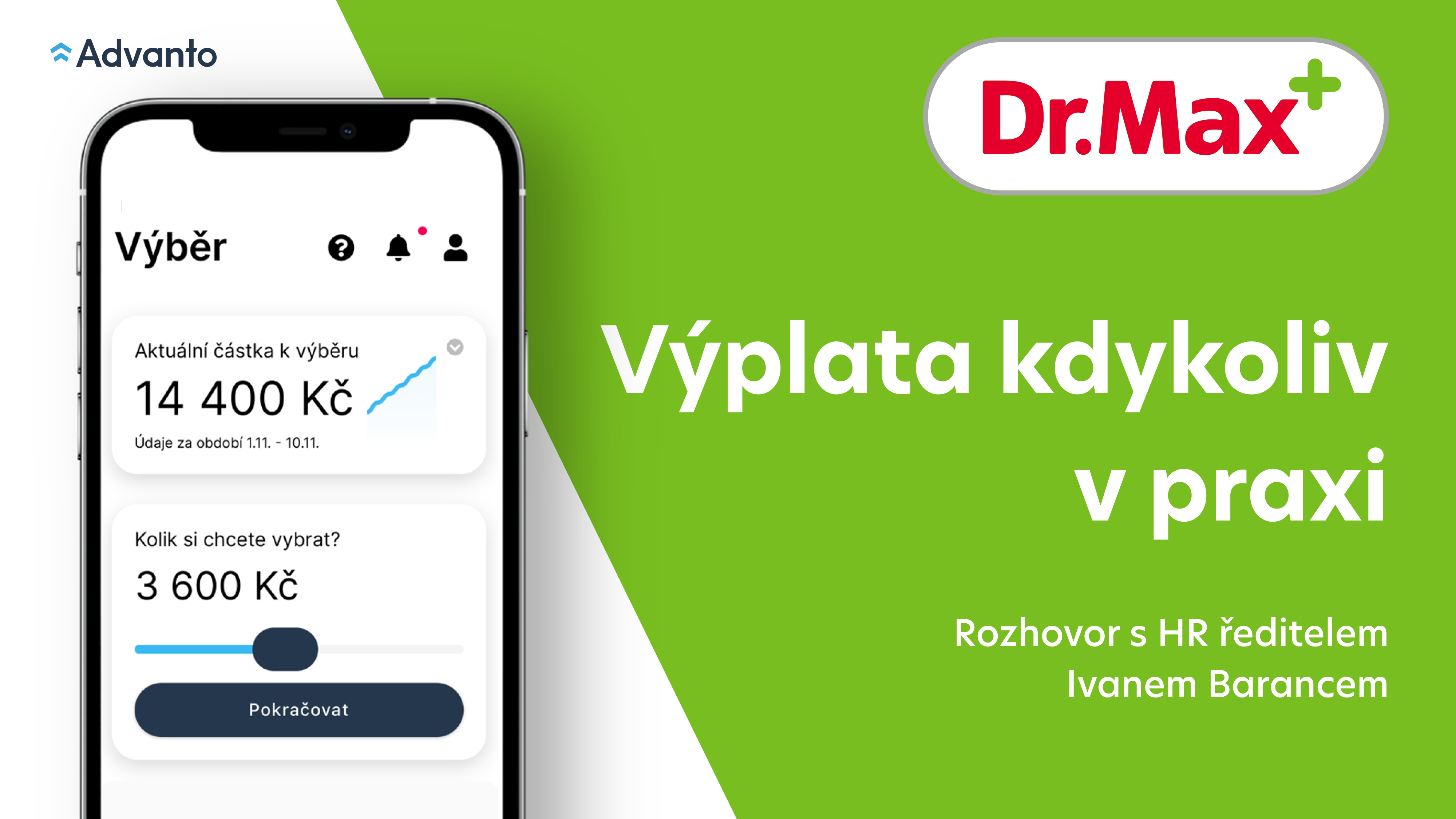
The Dr. Max pharmacy chain is one of the largest employers in the Czech Republic. With people in pharmacies, warehouses, and offices, it covers a wide range of professions. To increase comfort for its people and simplify access to their earned money, it implemented a solution from Advanto. It allows employees to withdraw part of their already earned wages at any time during the month via a mobile app, without waiting for the official payday and without an administrative burden for the company. We talked about the experience of introducing and running Earned Wage Access with Dr. Max HR Director Ivan Baranec.
The impulse and the decision
What led you to the idea of introducing the Earned Wage Access programme?
The main impulse was the effort to offer employees a new service and, at the same time, to clearly differentiate ourselves from the competition on the labour market.
Was it more pressure from the labour market, or an internal need (e.g. turnover, employee satisfaction)?
It was a combination of both. We felt the pressure of the labour market as well as the internal need to further strengthen our attractiveness as an employer and employee satisfaction.
What role did the company's structure (warehouses, pharmacies, e-shop) play in your decision-making?
The company's structure played an important role. Demand for a service of this kind was initially more pronounced particularly among employee groups with lower incomes, but in practice it turned out that employees across the entire company use it regardless of position and income level.
Did you consider other programmes or solutions as well?
Yes, we also considered an in-house solution, but we were put off implementing it by the higher administrative burden.
Expectations and goals
What did you expect from introducing Earned Wage Access?
We expected Earned Wage Access to become a firm and long-term part of employee care at Dr. Max, not just a one-off or short-term solution.
Did you have goals defined in advance (e.g. reducing turnover, increasing recruitment attractiveness)?
The goals were rather soft ones – we focused primarily on increasing employee satisfaction, expanding our offering, and staying competitive on the labour market.
How did you picture the ideal state after launch?
The ideal state was for these expectations to be fulfilled, which is exactly what happened after the programme was launched.
Concerns and internal discussions
How did leadership/finance/other departments react to this programme?
The entire programme was the subject of intensive internal discussions. These mainly concerned setting up the process and conditions correctly from the perspective of financial and tax implications.
Did you have any concerns or doubts at the beginning?
The main concern at the beginning was the somewhat complicated setup of the fees associated with individual withdrawals.
What ultimately helped dispel these concerns?
It was mainly the fact that we truly devoted the necessary time, on the order of months, to analysing and setting up the conditions. This proved to be key for the future, and this detailed “homework” contributed to the subsequent fast implementation and a positive user experience. Practical experience was then decisive – it became clear almost from day one that the system and the process we had set up were intuitive and simple, and that employees embraced the programme very well.
Integration and implementation
How did the integration with the OKbase system go?
The integration with the OKbase system then went very smoothly. Advanto has these processes well mastered, so it required minimal effort on our side.
How complex (or, on the contrary, simple) and time-consuming was the implementation from your point of view?
Most of the time was taken up by the analysis, internal discussions, and setting the parameters on our side. The technical integration itself was then simple and fast.
Setting the rules
How did you approach setting the limits (how much employees can withdraw)?
The limits were set primarily on the basis of technical calculations and legislative requirements.
Was it important for you to have stricter or looser rules?
Our goal was to offer employees the maximum possible, while at the same time remaining fully within the legislative framework.
Did you adjust the settings over time based on experience?
No, there has been no need to make any further adjustments to the settings over time so far.
Communicating to employees
How did you introduce the programme to employees?
The programme was introduced to employees through our standard internal communication channels (intranet, e-mails, posters, the employee magazine…).
Did you target the communication differently for warehouses, pharmacies, and the e-shop?
Yes, the communication was tailored to the individual parts of the company. Each group of employees and each generation has its own specifics and preferred communication channels.
What worked best for you in the communication?
What worked best were practical how-to guides and the option of a first withdrawal free of charge, thanks to which employees could easily try the programme out. And of course – the best thing is when everything works right the first time – and that is what happened here.
Did employees need to be “educated” in some way, or did they understand the benefit naturally?
Employees understood everything naturally (also thanks to well-made, simple guides); the solution is very user-friendly and did not require any complicated education.
Employee response
What were the first reactions from employees after launch?
The reactions were generally positive. Employees welcomed the programme, tried it out, and began actively using it.
Did anything surprise you?
We were surprised that the programme is also used by employees from target groups or roles where we had not entirely expected it originally.
Did employees use this programme right away, or did it pick up gradually?
Employees started using the programme immediately. We expected significantly increased demand before Christmas, for example, but no notable spike occurred during that period.
Do you have any specific feedback or a story from employees?
We do not systematically collect specific individual stories. We see the programme as a service, support, and help for employees who need it at a given moment. We do not want to turn it into a marketing tool to sell ourselves with.
How Earned Wage Access works today
How does Earned Wage Access work in your company today?
It works stably, the same as at the beginning. We are glad that employees regularly use it every month.
Who uses it the most (e.g. type of position or operation)?
There is no specific group that would use this programme significantly more than others. Moreover, even if we tracked these numbers, it would not be appropriate to publish them.
Has anything changed in how your HR operates thanks to this programme?
This programme did not have a fundamental impact on how our HR processes work, but the occasional employee requests for a wage advance disappeared.
Are you tracking any specific impacts (e.g. turnover, absence, recruitment)?
We launched the programme at the end of last year, so we cannot quantify specific impacts yet.
What worked (and what didn't)?
What do you consider the programme's greatest benefit?
The greatest benefit is the low administrative burden combined with real value for employees, especially in unexpected life situations.
Would you do anything differently today?
Definitely not; even with hindsight, we would proceed in the same way.
Did you run into anything that did not work as expected?
We did not encounter anything that did not work as expected. As I mentioned, we spent a lot of time understanding, untangling, and systematically setting up the fees. This was absolutely key to the subsequent trouble-free operation.
The future of the solution
Do you see Earned Wage Access as a standard for the future?
Yes, unless something fundamentally changes on the market (legislation, employee expectations…), we see it as a standard part of our offering for employees going forward as well.
Would you recommend this programme to other companies too? Who does it make the most sense for?
Earned Wage Access makes sense for every company that handles individual wage advance payouts to employees, and perhaps also for those that do not deal with it yet, because unexpected financial situations can happen to anyone. So yes, I would definitely recommend the programme.
If you had to sum up the introduction of Earned Wage Access in one sentence, what would it be?
Earned Wage Access – a safe and simple way to get to part of your wages earlier.
Has Advanto caught your interest? Get in touch with us. We will be happy to tell you more about the benefit.